

%201.png)

Metal Roof Flashing: Installation, Types, and Common Issues

Metal roofing is growing rapidly in popularity across the Dallas-Fort Worth Metroplex, and for good reason. It offers incredible longevity, exceptional wind resistance, and unparalleled protection against severe hailstorms. However, upgrading to a metal roof involves much more than just swapping out the panels. The entire waterproofing system must be re-engineered, starting with the flashing.
If you read our Complete Guide to Roof Flashing Types, you know that flashing is the thin metal material that seals the joints and edges of a roof. While the basic purpose remains the same, metal roof flashing requires a fundamentally different approach than flashing on standard asphalt shingle roofs. This guide explains why metal roofs require specialized flashing techniques, the different types used, and the common problems that arise from improper installation.
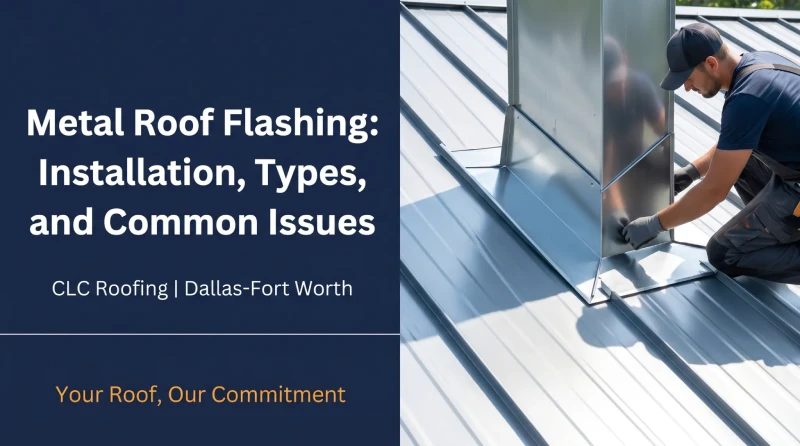
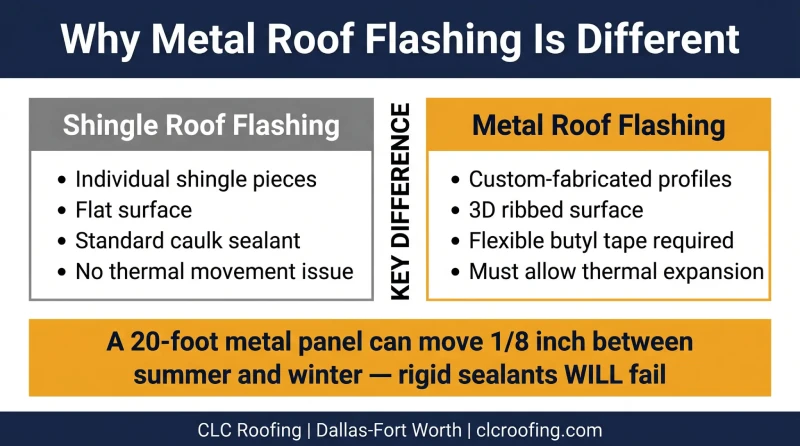
Flashing a metal roof presents two major challenges that simply do not exist with asphalt shingles. The first challenge is the roofing material's physical shape. Metal panels are continuous sheets that run from the bottom edge of the roof to the very top ridge. Furthermore, these panels feature raised ribs or standing seams, creating a three-dimensional surface. Standard flat flashing cannot lie flush against these raised ribs to create a watertight seal. The flashing must be custom-fabricated or sourced directly from the panel manufacturer to perfectly match the specific rib height and spacing of the installed panels.
The second, and more difficult, challenge is thermal movement. Metal expands when heated and contracts when cooled. Because metal panels are long, continuous sheets, this thermal movement is significant. A twenty-foot steel panel can move roughly one-eighth of an inch between the extreme heat of a Texas summer and the freezing temperatures of winter. This constant expansion and contraction pulls and pushes the panels against the flashing at every temperature cycle. If the flashing is nailed down too tightly or sealed with rigid caulk, the movement will literally tear the waterproofing system apart.
Because the surface of a metal roof is so unique, the flashing components must be designed to integrate perfectly with the panels while still allowing for movement.
Rake trim is the flashing placed along the sloping edges of the roofline where it meets the gable. The end of this trim must be carefully cut, angled, and folded to fit the side of the roof securely. Eave trim, also known as drip edge, is installed along the bottom horizontal edge of the roof. Its job is to keep water away from the roof fascia and direct rainwater straight down to the ground or into the gutters. For both of these trims, installers use flexible butyl tape on the underside of the nailing flange to create a moisture seal that will not crack when the metal shifts.
The peak or ridge trim is installed at the absolute highest point of the roof. Its primary purpose is to prevent wind-blown rain from intruding beneath the sloping panels at the top. Installers apply a thick layer of butyl tape sealant along the top edge of the panels, place an outside closure strip on top of the tape, and then cap it with the ridge trim. Fasteners are then applied directly to each major rib to secure everything.
Flashing a chimney on a metal roof is widely considered the most complex flashing detail in residential roofing. On a shingle roof, roofers simply weave small pieces of step flashing between the shingles as they work their way up the chimney. On a metal roof, this is impossible.
The installation requires custom-bent transition pieces that match the exact profile of the metal panels. For a standing seam roof, the roofer uses a clamp-and-flashing system that attaches to the vertical seams without ever penetrating the flat part of the panel.
For corrugated metal roof flashing, the roofer uses overlapping trim pieces, sealed with heavy-duty butyl tape at the ribs. In both cases, the flashing must extend under the upslope panels and turn up the chimney face, where it is covered by a counterflashing embedded in the brick mortar. Additionally, building codes require a cricket, which is a small, peaked diverter, behind any chimney wider than thirty inches to prevent water from pooling against the masonry.
Valley flashing is used in the V-shaped channels where two different roof planes intersect. This flashing must handle massive volumes of water while simultaneously accommodating the thermal expansion of the metal panels pushing into the valley from both sides. An open valley style, where the metal flashing is left exposed and the roof panels stop a few inches short of the center, is highly recommended to achieve optimal water flow and prevent debris buildup.
As mentioned earlier, thermal movement is the enemy of a watertight metal roof. If a roofing contractor tries to seal a metal roof with the same rigid polyurethane caulks used on shingle roofs, the seal will fail. The rigid caulk cannot stretch enough to handle the panel movement, so it cracks and breaks within a few seasonal cycles.
This is why professional metal roofers rely heavily on butyl tape. Butyl tape remains flexible across a massive range of temperatures, allowing it to stretch and compress as the metal panels move without ever losing its watertight grip. Furthermore, the flashing itself must be installed using slotted fastener holes or sliding clips. These specialized fastening systems hold the flashing securely to the roof deck while allowing the metal panels to slide back and forth beneath them as temperatures change.
When a metal roof leaks, the flashing is almost always the culprit. The most common problem is a mismatched profile. If a contractor uses generic flashing that does not perfectly match the spacing of the panel ribs, large gaps are left for wind-driven rain to enter.
Another frequent issue is the improper use of sealants. Using rigid caulk instead of flexible butyl tape guarantees a future leak. Finally, inexperienced installers often fail to account for galvanic corrosion. If incompatible metals are allowed to touch, such as a galvanized steel panel resting against a copper flashing piece, a chemical reaction occurs that causes the metals to rust and disintegrate rapidly.
No, standard step flashing is designed to be woven between individual asphalt shingles. Because metal panels are continuous sheets with raised ribs, step flashing cannot be used. You must use custom continuous flashing that matches the panel profile.
Chimney leaks on metal roofs are usually caused by thermal movement breaking the sealant bonds, missing butyl tape closures at the panel ribs, or the lack of a proper cricket behind the chimney to divert water.
The flashing material should generally match the roof panel material to prevent galvanic corrosion. Galvanized steel and aluminum are the most common. The thickness, or gauge, also matters. A thicker twenty-four-gauge metal provides much better protection than a thinner twenty-eight-gauge metal.
A metal roof is a significant investment that should last a lifetime, but it is only as good as the flashing that seals it. Installing metal roofing requires highly specialized training, precision metal-bending equipment, and a deep understanding of how metal behaves in the extreme Texas climate.
At CLC Roofing, our crews are expertly trained in the complex details of metal roofing installation. We know exactly how to fabricate and install custom flashing that keeps your home completely dry while allowing the roof to breathe and move naturally. If you are considering upgrading to a metal roof or need repairs on an existing system, contact CLC Roofing today for a professional consultation and estimate.
Get a Free Roofing Estimate Today!
Why Choose Us Over Other Roofing Companies in Dallas
From repairs to complete roof replacements, gutters, and painting, at CLC Roofing provides expert solutions where other roofing companies fail to protect and beautify your homes roof. Count on our experienced roofers for high-quality service and craftsmanship tailored to your needs.
• 25+ Years of Experience in Dallas, TX
• Owens Corning Platinum Preferred Contractor (1% of Roofers)
• Expert Storm Damage & Hail Repair
• High-Quality Materials: Metal, Slate, Tile & Impact-Resistant Shingles
• A+ Rated & 300+ 5-Star Reviews
• Advanced Drone Inspections & Precision Estimates

Expertise and Experience
With over 25 years in the Dallas roofing industry, Chad Cross and his team bring unparalleled knowledge and skills to every roof replacement project. Our extensive experience includes sales, project management, and manufacturer representation, ensuring we handle all aspects of your roofing needs with precision.
Stylish Finishing Touches
Every detail is meticulously crafted, ensuring your roof is as functional as it is visually striking. We deliver a seamless blend of style and utility.
Premium Materials
We use only the finest materials to ensure lasting beauty and durability. Your roof will look stunning and perform flawlessly for years.
Owens Corning Platinum Preferred Contractor
As an Owens Corning Platinum Preferred Contractor, we meet the highest standards for professionalism, reliability, and craftsmanship. This elite status allows us to offer the Owens Corning™ System Advantage® Platinum Roofing Limited Warranty, providing you with the strongest coverage, including lifetime workmanship.
Great Reviews for CLC Roofing Inc.
When your project is complete, we hope you'll describe your experience with CLC Roofing in one word: EXCELLENT! Serving the entire DFW Metroplex, we invite you to contact our roofing company today for a free roof inspection—you’ll be glad you did


Best Dallas Roofing Contractors Serving Dallas-Fort Worth and Surrounding Areas
CLC Roofing Inc. is proud to provide top-tier roofing services across North Texas, including:

CLC Roofing Inc. – Your Local Roofing Contractor
As your local roofing experts, we’re committed to delivering reliable, high-quality roofing solutions that stand the test of time. With extensive experience and a passion for excellence, CLC Roofing Inc. is here to serve you and your community.
%201.svg)


